
 English
 Chinese
 German
 Spanish
 French
 Portuguese
 Arabic
 Russian
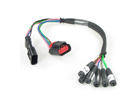




- Difference of the Different Specification Cables
- Datetime: 2026/5/29 0:00:00
Introduction
Automotive wiring harnesses, as the main network of the vehicle's electrical system, bear the dual mission of energy transmission and signal transmission. Like the blood vessels and nerves of the human body, they ensure the normal operation of various vehicle functions. Depending on the application scenario and standards, various types of wires are used in wiring harnesses, which differ significantly in voltage levels, conductor specifications, insulation materials, and compliance with standards.
I. Classification by voltage level: High-voltage wire harnesses and low-voltage wire harnesses
With the development of new energy vehicles, automotive wiring harnesses are clearly divided into two major systems: high voltage and low voltage.
l Low-voltage wires
are commonly used in the electrical control systems of both traditional gasoline-powered vehicles and new energy vehicles, typically operating at 12V or 24V. They primarily supply power and transmit signals to conventional electrical equipment such as headlights, instruments, sensors, and ECUs (electronic control units). To adapt to the complex wiring environment inside a vehicle, low-voltage wires are usually made of flexible, thin-diameter, multi-strand copper wire.
l High-voltage wires
are primarily used in new energy vehicles (pure electric and hybrid) to connect high-voltage components such as batteries, motors, and electronic controls, transmitting the powerful electrical energy required to drive the vehicle. The voltage is typically above 300V. Compared to low-voltage wires, high-voltage wires have the following significant differences:
n High voltage and high current: To carry high voltage and high current, its conductor cross-sectional area is much larger than that of low voltage lines.
n Emphasis on insulation and safety: The insulation layer is thicker, and there are higher requirements for heat resistance, insulation and flame retardancy to ensure safety in extreme situations.
n Shielding performance: To prevent strong electromagnetic interference generated by high voltage from affecting other electronic devices in the vehicle, high voltage wiring harnesses are usually equipped with a shielding layer.
n High-profile markings: The appearance of the wiring harness is usually bright orange as a warning sign.
II. Classification by conductor specifications (cross-sectional area)
Automotive wiring harnesses come in different specifications depending on the amount of current they can carry, and are usually distinguished by the nominal cross-sectional area of the conductor (unit: square millimeters mm²).
l Small cross-sectional area wires (such as 0.5mm², 0.75mm²): suitable for low-power loads, such as instrument lights, indicator lights, various sensor signal lines, door lights and ceiling lights, etc.
l Medium cross-sectional area conductors (e.g., 1.0mm², 1.5mm², 2.0mm²): used for devices with slightly higher power, such as front and rear lights, brake lights, turn signals, fog lights, and horns.
l Large cross-sectional area conductors (e.g., 2.5mm², 4.0mm², 6.0mm² and above): used in main power lines, such as generator lines, grounding wires and starter motors and other components that require the passage of large currents.
III. Classification according to national standards
1. The global automotive industry has developed different wire standard systems, mainly including German standard, Japanese standard, American standard and Chinese standard, which have their own characteristics in terms of insulation thickness, flexibility and other aspects.
|
Standards system |
Representative models |
Insulating materials |
Wall thickness characteristics |
Core advantages |
Common application scenarios |
|
German Standard (DIN/ISO) |
FLRY-A, FLRY-B |
PVC |
Thin-walled/ Ultra-thin-walled |
With its ultra-thin walls and excellent flexibility, it helps to reduce the weight and size of wire harnesses. |
Sensitive areas such as the cockpit, body control module, and instrument panel. |
|
American Standard (SAE) |
TXL, GXL, SXL |
Cross-linked polyethylene (XLPE) |
Thin-walled (TXL) to standard wall thickness (SXL) |
It uses cross-linked polyethylene (XLPE) insulation, which is resistant to high temperature (125°C+) and has excellent wear resistance. |
The engine compartment, gearbox, and other areas are in harsh environments with high temperature, high vibration, and easy wear. |
|
Japanese Standard (JASO/JIS) |
AVS, AVSS |
PVC |
Thin-walled (AVS), Ultra-thin-walled (AVSS) |
The insulation layer is thin and extremely flexible, with excellent bending properties, making it easy to wire in complex paths. |
Door wiring harnesses, seat wiring harnesses, headliner wiring harnesses, and other parts that require frequent movement or are located in confined spaces. |
|
Chinese National Standard (GB/QC/T) |
QVR |
PVC |
Standard wall thickness |
The insulation layer is thick, soft, and has good ductility, offering high cost-effectiveness and wide applicability. |
It is applicable to the conventional electrical systems of various domestic and joint venture vehicle models. |
2. The following are detailed differences between representative models within each standard system , presented in a table for clear comparison:
2.1 German Standard (DIN/ISO) Models: FLRY-A vs. FLRY-B
The key difference between these two types of wires lies in the twisting method of the conductors (copper wires), which directly affects the flexibility of the wire.
|
Model |
Conductor structure |
Insulation layer wall thickness (taking 0.5mm² as an example) |
characteristic |
|
FLRY-A |
Concentric |
Approximately 0.25 mm |
The conductor has a regular structure and the wire has a slightly higher hardness. |
|
FLRY-B |
Bunched |
Approximately 0.25 mm |
The conductor is made of multiple strands of fine filaments twisted together, making the wire very soft and highly flexible. |
Conclusion: For scenarios requiring frequent bending or cabling in extremely confined, winding spaces, FLRY-B's superior flexibility makes it the preferred choice. For conventional cabling, FLRY-A is perfectly adequate.
2.2 American Standard (SAE) Models: TXL vs. GXL vs. SXL
All three wires use high-temperature resistant cross-linked polyethylene (XLPE) insulation and have the same temperature rating. Their fundamental difference lies in the thickness of the insulation layer, which determines their weight, diameter, flexibility, and abrasion resistance.
|
Model |
Wall thickness grade |
Insulation layer wall thickness (taking 20 AWG ≈ 0.5mm² as an example) |
characteristic |
|
TXL |
Thin Wall |
Approximately 0.41 mm |
Thinnest, lightest, and most flexible, suitable for situations where space and weight reduction are of utmost importance. |
|
GXL |
General Purpose Wall Thickness |
Approximately 0.58 mm |
A medium thickness represents a balance between performance and size, making it the most widely applicable. |
|
SXL |
Standard wall thickness |
Approximately 0.76 mm |
Thickest, providing top-level mechanical protection and abrasion resistance, designed for harsh environments such as engine compartments. |
Conclusion: The selection path for US standards is very clear: the harsher the environment, the thicker the wall thickness should be. From TXL to SXL, the protection level and durability increase sequentially.
2.3 Japanese Standard (JASO/JIS) Models: AVS vs. AVSS
Similar to the American standard, the main difference between these two Japanese models is the insulation thickness.
|
Model |
Wall thickness grade |
Insulation layer wall thickness (taking 0.5mm² as an example) |
characteristic |
|
AVS |
Thin-walled |
Approximately 0.50 mm |
Standard thin-walled automotive wires with good flexibility. |
|
AVSS |
Super Slim |
Approximately 0.30 mm |
With thinner insulation, smaller outer diameter, lighter weight, and greater flexibility, it is the preferred choice for miniaturized and lightweight designs. |
Conclusion: AVSS is an upgraded version of AVS, better suited to the modern automotive design trend towards compactness and lightweighting.
2.3 Chinese National Standard (GB/QC/T) Model Description: QVR
The national standard QVR (copper core PVC insulated automotive flexible wire) is a basic model, and its wall thickness is not clearly subdivided into grades like the standards mentioned above.
l Wall thickness: It is usually referenced to a thickness similar to the Japanese standard AVS, but there is no mandatory uniform standard, and different manufacturers may have different thicknesses. Its design feature is a relatively thick insulation layer to ensure good insulation performance and durability.
l Its core advantages lie in its high cost-effectiveness and its wide applicability as a domestic general standard.
IV. Classification by Insulation Material
The choice of insulation material directly determines the key properties of wires, such as temperature resistance, corrosion resistance, and abrasion resistance.
l Polyvinyl chloride (PVC): It is one of the most commonly used insulation materials in automotive wiring harnesses, but its long-term operating temperature is usually below 105°C.
l Cross-linked polyethylene (XLPE): It can withstand long-term operating temperatures above 125℃, has superior mechanical strength and wear resistance, and is halogen-free, making it more environmentally friendly and safe.
l Cross-linked polyolefins (XLPO): They have excellent halogen-free flame retardancy, low smoke and harmlessness, and outstanding flexibility, and are often used in areas with high requirements for temperature rating and flexibility.
l Ethylene-tetrafluoroethylene copolymer (ETFE): It has a temperature resistance rating of up to 150℃ and performs well in terms of resistance to chemicals such as oil, acids and alkalis, making it suitable for extreme and harsh environments such as engine compartments.
V. Classification by Special Functions
To meet the growing demands for electrification and intelligence in automobiles, wiring harnesses also include some wires with special functions.
l Shielded wires: These are wires wrapped with a layer of metal braid or aluminum foil to protect the weak signals transmitted inside from external electromagnetic interference. They are commonly used in ECU control systems, sensor signal lines, and in-vehicle entertainment systems.
l Twisted pair: Two signal wires are twisted together to resist external interference and crosstalk between wire pairs using the principle of electromagnetic induction. It is widely used in automotive communication networks such as CAN bus.
Summarize
There are many types of wires in automotive wiring harnesses. It is necessary to comprehensively consider multiple factors such as vehicle design requirements, cost, working environment and safety to select the most suitable "blood vessels" for different electrical systems to ensure the safe, reliable and comfortable operation of the car.



- Tel: +8618858817366
- Fax:
- Skype:
- E-mail: sales@kinkong-connector.com
- Website: https://www.kinkong-connector.com/
- Website: www.kinkongseal.com
- Website: www.kinkongwireharness.com
- Website: www.kinkong.com


- Online Preview